EXP-001 · Espresso · TemperaturaEspresso · Temperature
Temperatura en espresso: elige qué se extrae, no cuántoEspresso temperature: it picks what gets extracted, not how much
Diez shots de 20 g, de 88 a 97 °C. El refractómetro casi no se movió; la taza pasó de 0 a 2,5.Ten 20 g shots, from 88 to 97 °C. The refractometer barely moved; the cup went from 0 to 2.5.
ResumenSummary
Con 20 g de café a un ratio fijo de 1:2,0, subí la temperatura del agua de 88 a 97 °C, un grado por shot. La extracción casi no cambió, pero la taza sí: la nota de cata fue de 0 a 2,5. El mejor punto fue 93 °C, dentro de una zona buena entre 92 y 95 °C.
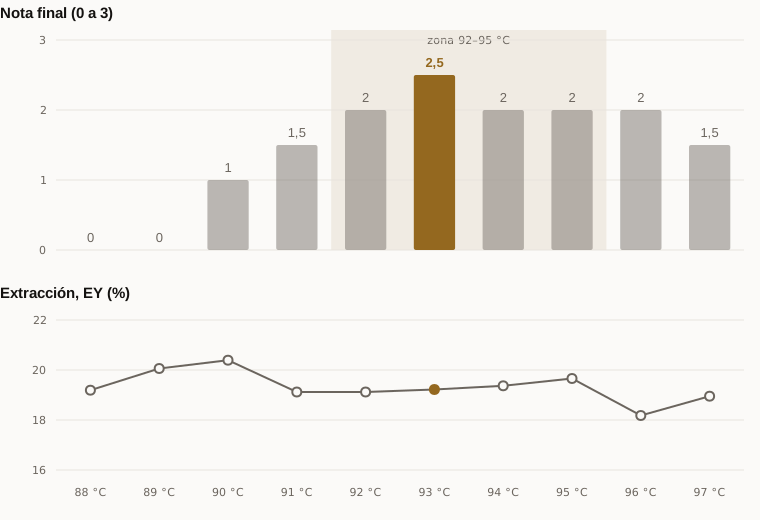
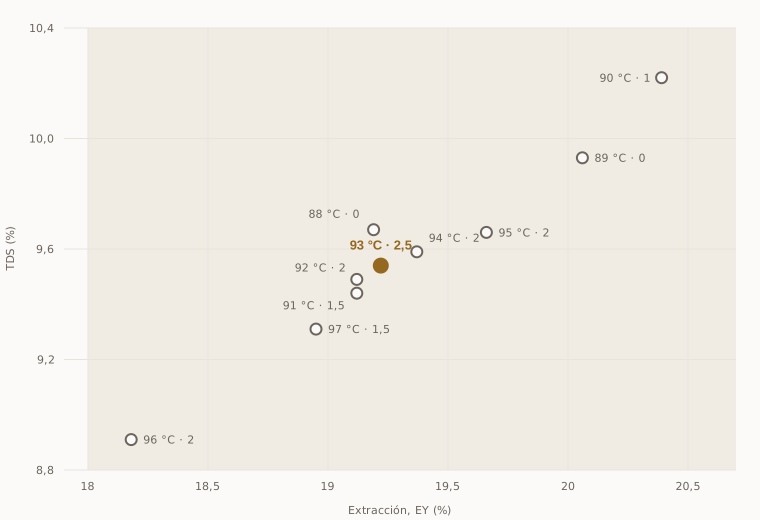
- La temperatura elige qué se extrae, no cuánto. La EY quedó entre 18,2 y 20,4 % sin tendencia, mientras la taza iba de "fruta inmadura, áspera" a "durazno en almíbar, piña caramelizada".
- Es una perilla tolerante. Cuatro grados, de 92 a 95 °C, dieron nota 2 o más.
- Balanceado no es lo mismo que memorable. A 94 °C la taza fue "perfecta para cafetería"; a 93 °C fue la que dejó huella.
With 20 g of coffee at a fixed 1:2.0 ratio, I raised the water temperature from 88 to 97 °C, one degree per shot. Extraction barely changed, but the cup did: the cupping score went from 0 to 2.5. The best point was 93 °C, within a good zone between 92 and 95 °C.
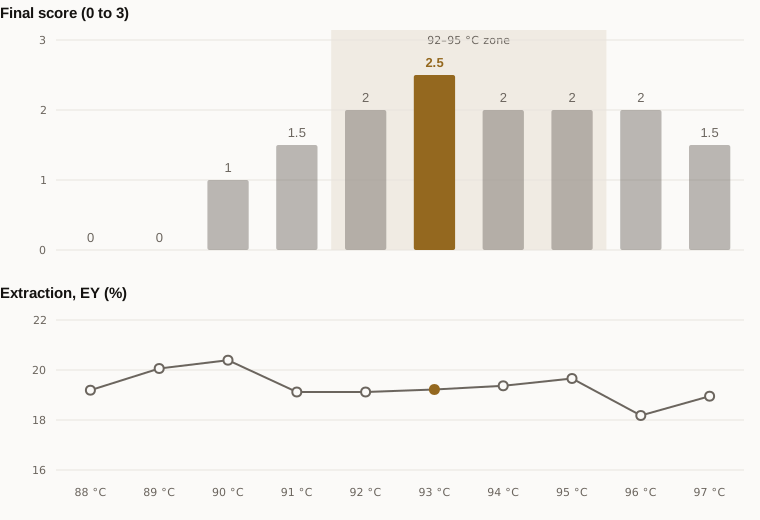
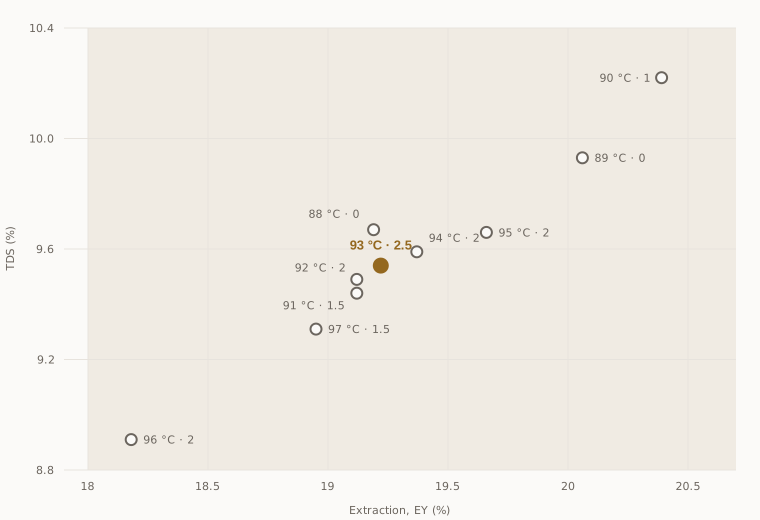
- Temperature picks what gets extracted, not how much. EY stayed between 18.2 and 20.4 % with no trend, while the cup went from "unripe fruit, harsh" to "peach in syrup, caramelized pineapple".
- It's a forgiving dial. Four degrees, from 92 to 95 °C, scored 2 or higher.
- Balanced is not the same as memorable. At 94 °C the cup was "perfect for a café"; at 93 °C it was the one that stuck with me.
Pregunta
¿Qué cambia en un espresso cuando muevo solo la temperatura del agua y dejo todo lo demás fijo?
Método
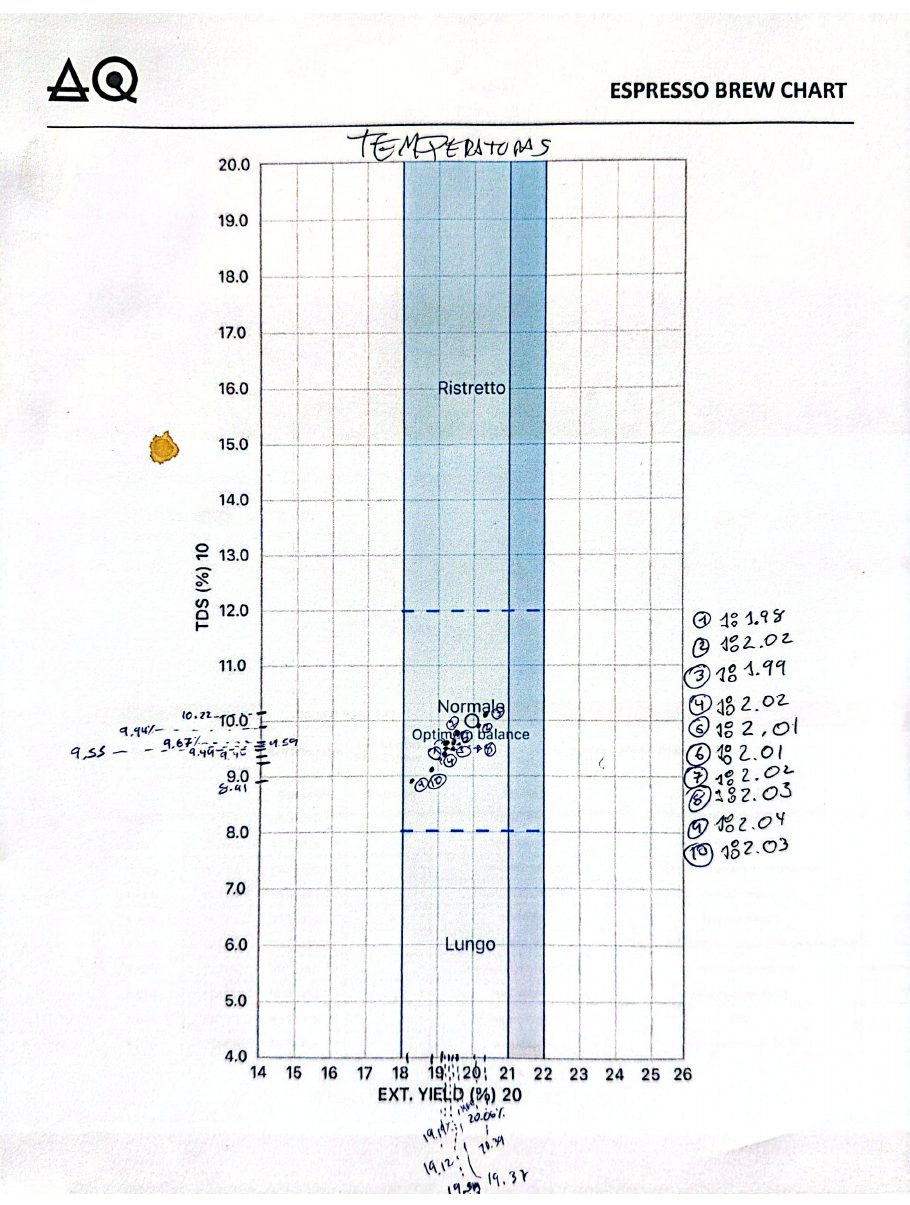
Preparé 10 shots con el mismo café y la misma receta, cambiando únicamente la temperatura: de 88 a 97 °C, subiendo un grado por shot. El ratio se mantuvo entre 1:1,99 y 1:2,04 y el tiempo entre 21 y 23 segundos. Cada shot se midió con refractómetro y se cató con una ficha de nota final de 0 a 3. El equipo completo está en la ficha del experimento.
| Variable | Valor |
|---|---|
| Dosis y ratio | 20 g → ~40 g (1:2,0) |
| Temperatura | 88 → 97 °C, en orden ascendente |
| Tiempo | 21–23 s |
| Molienda | 2.4 |
| Medición | Refractómetro y ficha de cata (nota final 0–3) |
Datos
| Shot | Temperatura | Bebida | Tiempo | TDS (%) | EY (%) | Nota final |
|---|---|---|---|---|---|---|
| 1 | 88 °C | 39,7 g | 23 s | 9,67 | 19,19 | 0 |
| 2 | 89 °C | 40,4 g | 22 s | 9,93 | 20,06 | 0 |
| 3 | 90 °C | 39,9 g | 23 s | 10,22 | 20,39 | 1 |
| 4 | 91 °C | 40,5 g | 22 s | 9,44 | 19,12 | 1,5 |
| 5 | 92 °C | 40,3 g | 21 s | 9,49 | 19,12 | 2 |
| 6 | 93 °C | 40,3 g | 23 s | 9,54 | 19,22 | 2,5 |
| 7 | 94 °C | 40,4 g | 23 s | 9,59 | 19,37 | 2 |
| 8 | 95 °C | 40,7 g | 23 s | 9,66 | 19,66 | 2 |
| 9 | 96 °C | 40,8 g | 22 s | 8,91 | 18,18 | 2 |
| 10 | 97 °C | 40,7 g | 21 s | 9,31 | 18,95 | 1,5 |
Datos de la bitácora del 1 de noviembre de 2026. Todos los shots con 20 g de café molido, refractómetro VST Labs.
Resultado
La temperatura no cambió cuánto se extrajo, sino qué se extrajo. Funcionó más como un selector de sabores que como una perilla de volumen.
| Zona | Temperatura | En la taza | Nota |
|---|---|---|---|
| Fría | 88–89 °C | Fruta inmadura, verde, áspera, astringente, algo metálica | 0 |
| Tibia | 90–91 °C | Aparecen durazno y mango, todavía algo inmaduros | 1–1,5 |
| Punto dulce | 92–95 °C | Miel, durazno en almíbar, mango, piña caramelizada | 2–2,5 |
| Caliente | 96–97 °C | Limpia pero plana; luego amarga, terrosa y seca | 1,5–2 |
- La sequedad aparece en los dos extremos, pero es distinta. En frío es la astringencia de la fruta verde; en caliente, una sequedad de cáscara con amargor.
- Balanceado no es memorable. A 94 °C la taza fue extremadamente balanceada, perfecta para cafetería, pero sin experiencia. A 93 °C fue "wow, tropical", con un pico de acidez que le daba vida. Para servicio usaría 94 °C; para competencia, 93 °C.
Por qué la EY no se movió
Interpretación, no medido. Los ácidos y aromas frutales se disuelven rápido incluso con agua menos caliente, mientras que los compuestos dulces y caramelizados necesitan más energía; con mucha temperatura entran también los amargos y secos. Por eso el balance cambia aunque el total disuelto sea parecido. Además, en espresso el tiempo y la molienda pesan más sobre el total extraído, y el cambio que pudo haber en EY, unas décimas, quedó dentro de la variación normal entre shots.
Qué aprendí
- La temperatura define el carácter de la taza. Con la extracción prácticamente igual, pasé de una taza verde y áspera a una dulce y tropical.
- Hay margen para trabajar. Entre 92 y 95 °C la taza fue buena; dentro de esa zona, cada grado cambia el estilo más que la calidad.
- Para ajustar, la taza manda. Si sale verde o agria, subo 1 °C; si sale amarga, seca o plana, bajo 1 °C. Un buen punto de partida es 93 °C.
Question
What changes in an espresso when I move only the water temperature and keep everything else fixed?
Method
I pulled 10 shots with the same coffee and the same recipe, changing only the temperature: from 88 to 97 °C, one degree per shot. The ratio stayed between 1:1.99 and 1:2.04 and the time between 21 and 23 seconds. Each shot was measured with a refractometer and cupped on a final-score sheet from 0 to 3. The full equipment list is in the experiment sheet.
| Variable | Value |
|---|---|
| Dose and ratio | 20 g → ~40 g (1:2.0) |
| Temperature | 88 → 97 °C, in ascending order |
| Time | 21–23 s |
| Grind | 2.4 |
| Measurement | Refractometer and cupping sheet (final score 0–3) |
Data
| Shot | Temperature | Beverage | Time | TDS (%) | EY (%) | Final score |
|---|---|---|---|---|---|---|
| 1 | 88 °C | 39.7 g | 23 s | 9.67 | 19.19 | 0 |
| 2 | 89 °C | 40.4 g | 22 s | 9.93 | 20.06 | 0 |
| 3 | 90 °C | 39.9 g | 23 s | 10.22 | 20.39 | 1 |
| 4 | 91 °C | 40.5 g | 22 s | 9.44 | 19.12 | 1.5 |
| 5 | 92 °C | 40.3 g | 21 s | 9.49 | 19.12 | 2 |
| 6 | 93 °C | 40.3 g | 23 s | 9.54 | 19.22 | 2.5 |
| 7 | 94 °C | 40.4 g | 23 s | 9.59 | 19.37 | 2 |
| 8 | 95 °C | 40.7 g | 23 s | 9.66 | 19.66 | 2 |
| 9 | 96 °C | 40.8 g | 22 s | 8.91 | 18.18 | 2 |
| 10 | 97 °C | 40.7 g | 21 s | 9.31 | 18.95 | 1.5 |
Data from the November 1, 2026 logbook. All shots with 20 g of ground coffee, VST Labs refractometer.
Result
Temperature didn't change how much was extracted, but what was extracted. It worked more like a flavor selector than a volume knob.
| Zone | Temperature | In the cup | Score |
|---|---|---|---|
| Cold | 88–89 °C | Unripe, green, harsh, astringent fruit, slightly metallic | 0 |
| Warm | 90–91 °C | Peach and mango appear, still somewhat unripe | 1–1.5 |
| Sweet spot | 92–95 °C | Honey, peach in syrup, mango, caramelized pineapple | 2–2.5 |
| Hot | 96–97 °C | Clean but flat; then bitter, earthy and dry | 1.5–2 |
- Dryness shows up at both ends, but it's different. Cold, it's the astringency of green fruit; hot, it's a peel-like dryness with bitterness.
- Balanced isn't memorable. At 94 °C the cup was extremely balanced, perfect for a café, but without an experience. At 93 °C it was "wow, tropical", with a lift of acidity that brought it to life. For service I'd use 94 °C; for competition, 93 °C.
Why EY didn't move
Interpretation, not measured. Fruity acids and aromas dissolve quickly even in cooler water, while sweet and caramelized compounds need more energy; at high temperatures, bitter and drying compounds come in too. That's why the balance changes even when the total dissolved is similar. In espresso, time and grind also weigh more on total extraction, and whatever change there may have been in EY, a few tenths, stayed within normal shot-to-shot variation.
What I learned
- Temperature defines the character of the cup. With extraction practically the same, I went from a green, harsh cup to a sweet, tropical one.
- There's room to work. Between 92 and 95 °C the cup was good; within that zone, each degree changes the style more than the quality.
- When dialing in, the cup decides. If it tastes green or sour, I go up 1 °C; if it's bitter, dry or flat, I go down 1 °C. A good starting point is 93 °C.
El refractómetro te dice si estás en rango, pero solo la taza te dice si llegaste. La temperatura no suma extracción: elige qué parte del café llega a la taza.The refractometer tells you if you're in range, but only the cup tells you if you've arrived. Temperature doesn't add extraction: it chooses which part of the coffee reaches the cup.
RegistroRecord
© 2026 Nicolás Vargas Ochoa. Experimento realizado y documentado por el autor el 1 de noviembre de 2026. Puedes compartirlo citando la fuente y sin fines comerciales (© 2026 Nicolás Vargas Ochoa. Experiment carried out and documented by the author on November 1, 2026. You may share it with attribution, for non-commercial use (CC BY-NC 4.0).
Cómo citar:How to cite: Vargas Ochoa, N. (2026). Temperatura en espresso: elige qué se extrae, no cuántoEspresso temperature: it picks what gets extracted, not how much. EXP-001. nicolasvargas.coffee/experimentos/exp-001/